


The Strip
When I was growing up, sports in my house meant baseball and football. Then NASCAR showed up and changed the channel permanently. My Aunt Margie became a Jeff Gordon devotee. My brother's family followed the sport with the same intensity they reserved for Disney. I watched races with them. I appreciated Days of Thunder for what it was. But the oval never grabbed me. Two hundred left turns felt like a long way to go to end up where you started.
Formula 1 was always in the back of my mind as the alternative. Curves instead of circles. A different country every other weekend. Something that felt more like a puzzle being solved at speed than a parade with engines. I never watched it seriously. NASCAR owned the American market and F1 felt like someone else's sport.
Then the movie came out. Then Apple TV. I watched a race.
The racing itself was interesting. Different from NASCAR but not necessarily better — just operating by different rules, asking different questions of the drivers. What held my attention more than the cars, more than the strategy, more than the crashes, was a narrow column of data on the left side of the screen.
The Timing Tower.
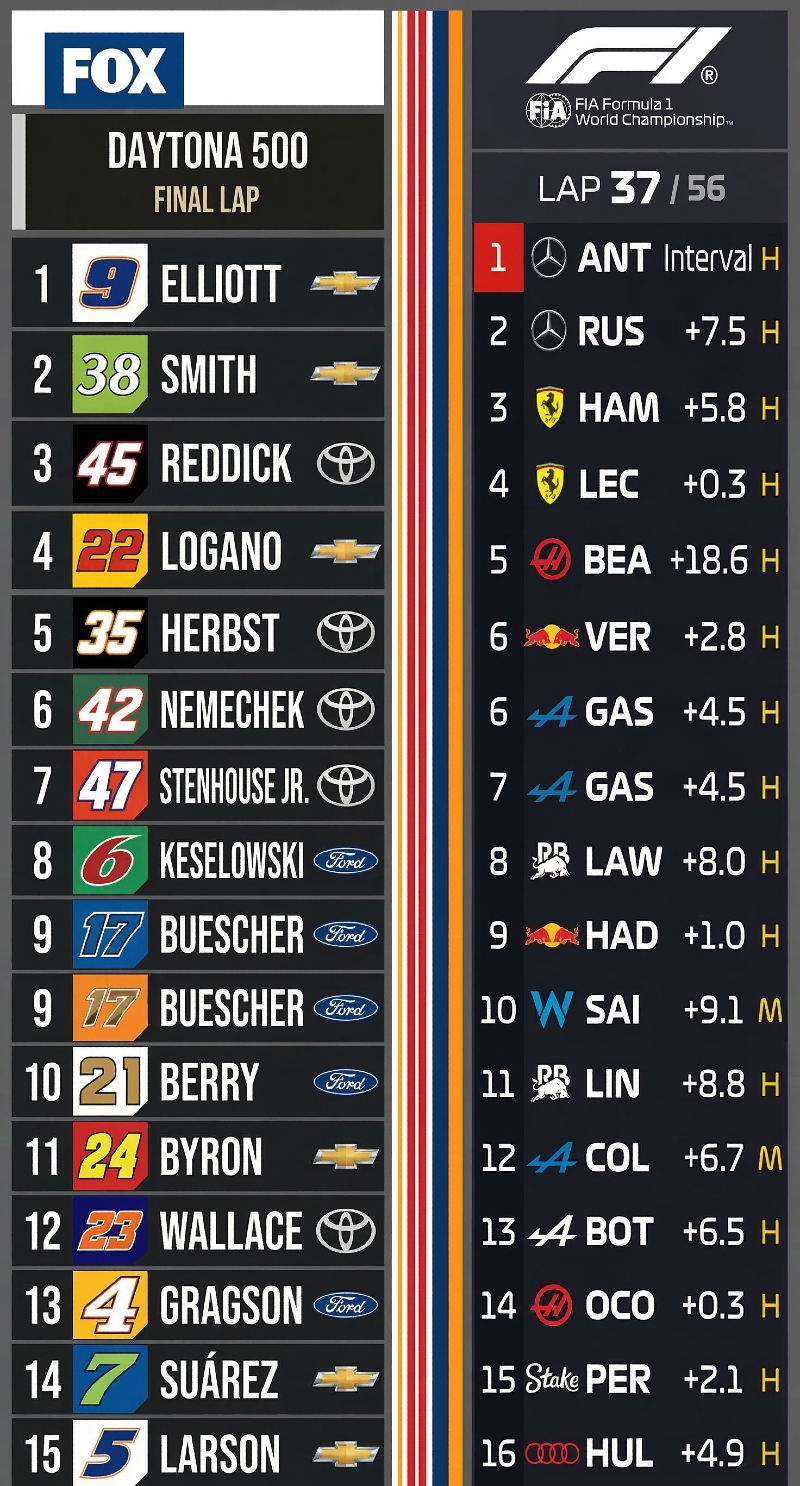
Position. Gap to leader. Tire compound. Sector time. Everything you need to understand the race in one compact column, updating in real time. NASCAR has its own version — neither sport copied the other, they both arrived at the same solution because it was the right one. But F1 has been refining it longer, and timing matters more when every corner is different and every sector tells a different story.
I'm not an F1 expert. One race doesn't make me anything. But that tower kept pulling my eyes away from the cars and I couldn't stop thinking about why. Eventually I figured it out. It wasn't the data. It was what the data made visible. The distance between things. The story underneath the race.
That realization led me somewhere I didn't expect.
The problem nobody names
Publishers have websites. Do they have presence? There is a difference between the two and it is pure emotion.
Having presence means the reader knows they exist as part of something bigger. A standard publisher website is a resource — articles, archives, a search bar. Useful. Forgettable. That's not presence. That's not recognizing your audience as participants in something rather than consumers of something.
There are real exceptions.
404 Media launched in 2023. Four journalists from Vice, a Stripe account, and a belief that good work would find people willing to pay for it. Defector was born the moment its staff walked out of Deadspin rather than be told to stick to sports. Hell Gate covered New York City local news with the intensity of a publication that believed the story mattered, and readers responded — double the subscription revenue in year two, profitable by 2025.
Visit any of these sites. Read the comments. Notice how readers talk about these publications like they belong to them. The soul is absolutely there.
Now look at the interface.
Clean. Fast. Functional. A reverse-chronological feed of articles. Virtually indistinguishable from a publication with no community at all.
That's the gap. The soul is present. The interface doesn't know it yet.
The blog era at least tried to close that gap. RSS feeds, comment sections, blogrolls — crude tools, but they created ambient community. You were part of a conversation even when you were just reading. That feeling mostly vanished when publishing consolidated onto platforms that traded presence for reach. Substack gives you a newsletter. Medium gives you distribution. Neither gives you a place.
The reverse-chronological feed tells you what was published and when. It tells you nothing about what's alive right now — where attention is gathering, what conversation you'd be walking into, what the community decided mattered today.
That's what the strip is for.
Interface without soul
Here's where I made my first wrong turn.
The Timing Tower works in F1 because the underlying reality is genuinely tense. The strip doesn't manufacture that tension — it makes existing tension legible. I thought the same grammar would translate anywhere. Position, gap, momentum — these feel universal. So I built a demo that applied the same interface to five different data domains. Box office numbers. Trending tech topics. Stock movers. Sports standings. Book buzz scores.
Same visual grammar. Completely flat.
The stock ticker version looked impressive. It moved. It updated. It ranked things. But watching it felt like watching a well-designed clock in an empty room. The mechanism was elegant. There was nothing at stake.
That's when I understood the actual problem. I hadn't built the strip for the wrong reasons. I'd applied it to the wrong context.
A stock ticker has the interface without the soul. Defector and Hell Gate have the soul without the interface. The strip only earns its emotion when the data underneath it has two things: genuine uncertainty and real consequence for the viewer. Nobody's pulse quickens because Dune is outperforming Conclave. But a reader who has followed a publication for three years, who has argued in the comments and recommended articles to friends and renewed their subscription twice — that reader has skin in the game. For them, knowing what's alive in this community right now means something.
The interesting question isn't whether the strip is a good interface. It's what happens when a publication that already has the soul finally gets an interface that can hold it.
Ali's boost
Let me tell you about Ali.
Ali works at an independent bookstore. The kind of place that survived Amazon by being irreplaceable — staff who actually read the books, handwritten shelf tags with genuine opinions, the specific atmosphere of a room where the people running it care more about what you read next than how quickly you leave.
The website, predictably, is a business card. Hours. Address. A contact form. The soul of the store lives in the physical space and nowhere else.
Now imagine a vertical panel on that store's website. Not algorithmic. Not driven by sales data or trending searches. A column of genres, manually ranked by the staff, updated whenever something shifts on the floor.
Horror is at number one today. Not because an algorithm flagged it. Because Ali boosted it this morning after three separate customers came in asking what to read after finishing Mexican Gothic. You tap the panel and her note is right there: "Three customers came in after Mexican Gothic — all asking what's next. Best horror shelf we've had in months."
That's not a feature. That's a human being paying attention, and a system that finally makes that attention visible to the people who would care about it.
The reason it works — the reason it carries emotional weight where the stock ticker didn't — is attribution. The boost is signed. The reason is given. If you love this bookstore, Ali's note means something specific. It's not a signal from an algorithm optimizing for engagement. It's a message from a person whose taste you've learned to trust, delivered through an interface that knows what it's carrying.
The staff diary builds over time. Every boost, every note, timestamped and attributed, becomes a record of what this community paid attention to and why. The interface has learned the soul of the place.
Back to the publication
The bookstore is a small version of a bigger idea.
An independent publication with a live content strip isn't trying to manufacture something. It's trying to surface what already exists — the fact that this community is active, that readers are invested, that being here means participating in something rather than consuming something.
But here's what matters most: the strip shouldn't be purely algorithmic.
Analytics and an AI content index can do a tremendous amount. They can surface what's getting unusual velocity. They can identify which articles are generating real conversation versus which ones are being skimmed. They can show what the community collectively cares about in a given week without any human having to watch a dashboard.
What they can't do is tell you why it matters. That's the editor's job.
An editor boost works exactly like Ali's boost. One tap. An optional note. A human layer sitting on top of the system's pattern recognition. The analytics know this piece is moving. The editor knows it's the third article in a series that's been building for six months and this one finally breaks it open. That context is the difference between a data point and a story.
There's something else. The readers of independent publications — the ones who subscribe to Defector and Hell Gate and 404 Media — are often specifically skeptical of algorithmic curation. They left the big platforms partly to escape it. A strip that shows both signals — what the data says is alive and what the editor thinks is worth your attention — and displays editor notes with attribution, says something an algorithm can never say on its own: a person is paying attention here.
When those two signals agree, the reader can trust the heat is real. When they diverge — when an article is low-traffic but boosted with a note saying this is the most important thing we've published this month — that divergence is itself information. A purely algorithmic strip can't do that. The human layer is what makes it trustworthy rather than just impressive.
Something shifted in 2023. The developers who'd spent three years evangelizing Linux on the desktop started showing up to meetups with MacBooks again. Not reluctantly — enthusiastically.
The Apple Silicon transition did something no one quite predicted: it collapsed the performance gap so completely that the conversation stopped being about specs and started being about workflow.
What followed was subtler. A whole ecosystem of tools rebuilt themselves around the assumption that their users were on Apple hardware. Raycast. Warp. Linear. Even the terminal emulators got beautiful.
Paired with an editorial navigation system that understands the publication's content architecture — sections, tags, the relationships between ideas — the strip completes a picture. One layer is the editorial map: here's how this publication organizes what it knows. The live strip is the weather: here's where attention is right now, and here's what someone who knows this publication thinks you should know about it.
No independent publication currently has both. Most don't have either.
Not solving problems
The strip doesn't solve a problem in the conventional product sense. Nobody's losing subscribers specifically because their site feels like an archive. No conversion rate is suffering from the absence of a live ranked content interface.
But let's be honest about what most publishing interface design does optimize for. It isn't the reader. It's the advertiser.
The architecture of the commercial web — the infinite scroll, the autoplay video, the notification prompt, the rabbit hole of related content — wasn't designed to make reading better. It was designed to extend session time in service of ad impressions. The reader's attention is the product. The interface is the harvesting machine.
Independent publishers who moved to subscription models largely escaped this. Defector pulled 95 percent of its revenue from subscribers in year one and stopped running ads. When your reader is your customer instead of your inventory, the design incentives change. You're no longer optimizing for time-on-site at any cost. You're optimizing for the kind of experience that makes someone glad they paid.
That's the context where an interface designed around the reader would actually mean something — not as a rebranded engagement trap but as a genuine attempt to show the community what it already is. Most independent publications haven't asked that question yet. They inherited their interface from platform conventions designed for a world where the reader was the product, and they never replaced it.
What the strip proposes — along with the other interaction experiments I've been working on — isn't a solution. It's an alternative way of experiencing a publication. One designed around the fact that some readers are genuinely invested, that some editors genuinely care, and that the gap between what these communities are and what their interfaces show has been open long enough.
Christopher Alexander spent a career arguing that good design creates aliveness — not just function, not just beauty, but a quality of felt presence that makes a space more inhabitable. He was talking about buildings. The question I keep coming back to is what aliveness means for a reading interface. What would it feel like if the site knew what the community already knew about itself?
The soul is already there in the best independent publications. The strip — with an editor's hand on it — is one way to finally show it.
What this points toward
I want to be careful here. What I'm describing doesn't fully exist yet.
The vision is clear: a publishing platform where content is alive, community is visible, and editorial identity comes through the interface itself — not just the words. Getting there requires a content index that understands article relationships and synthesizes behavioral signals. A ledger that remembers what individual readers care about. An editorial suggestion engine. And a boost mechanic simple enough that editors actually use it.
Some of this is built. Some of it isn't. I'm publishing this now because the thinking is clear enough to be useful even before the infrastructure catches up.
If you're running an independent publication and something here resonates — the idea that your interface could finally express the community you've already built — I'd like to talk.
If you're a designer or developer who sees a different version of this, I'd like to hear it. The best version of this probably doesn't come from one studio working in isolation.
The strip is running. But it turns out the same signals that make it possible can do something else entirely — something I didn't anticipate when I started building.
...but that's another story.
FunnelMelt builds publishing systems for independent voices. The Indy theme, the Norman theme, and the design thinking behind them live at funnelmelt.com.