
Island Radio
There's a specific kind of knowing that only exists in small places.
Tybee Island, Georgia, where I grew up, has about three thousand permanent residents. It's a barrier island — seven miles of road in, same seven miles out. In the summer it swells with tourists, but they don't change what it is. They're weather passing through. The community is something else.
I don't mean community in the way that word gets used on the internet. I mean the specific texture of actual knowing. You ran into the same people at the same places. You knew the owner of the surf shop had a daughter who'd just left for college and that he was quieter about it than he probably wanted to be. You knew when something happened — really happened, not just happened online — because the information traveled through real channels. Someone told someone who told you directly.
There was no algorithm deciding what you saw. The feed was just: what happened, in the order it happened, to people you actually knew.
I didn't think about that experience consciously for years. It was just what growing up felt like. Normal, the way anything is normal until you leave it and lose it and only then understand what it was.
This is about the moment I recognized it in something I'd built.
The Experiment I Almost Forgot About
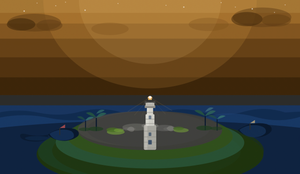
Around 2021, I designed a social network called Island Social.
I want to be clear about the context. I wasn't on a mission to rebuild Tybee on the internet. I was a designer with a head full of problems and a whiteboard and the particular kind of restlessness that produces speculative projects. The problem I was turning over was one that anyone who's tried to build community online eventually runs into: the spaces are either intimate and dead, or alive and impersonal. Too small and nothing happens. Too big and no one knows anyone. The middle — genuinely alive, genuinely intimate — seemed structurally elusive.
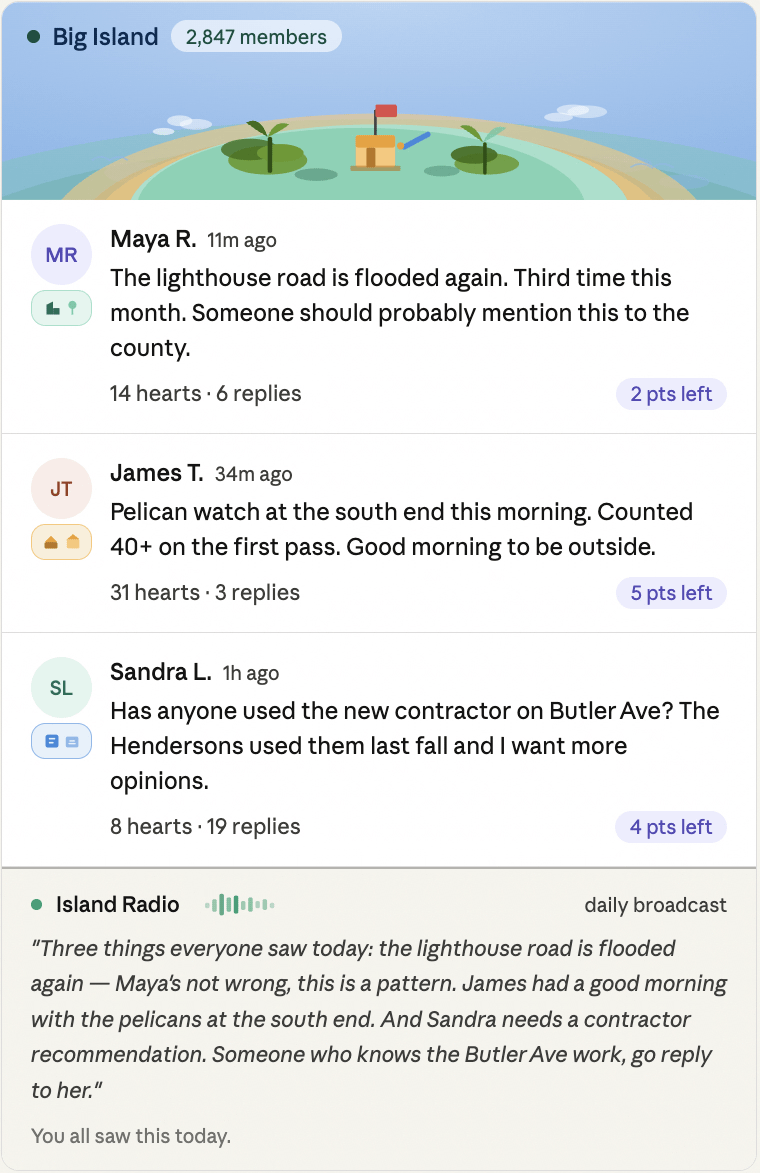
My answer was scale caps. Big Islands — the main communal spaces — capped at five thousand people. Large enough to feel alive. Small enough that the community could have a coherent identity. If a Big Island filled up, a new one formed rather than the original diluting.
Personal Islands were spaces rather than profiles. Your island had an address, an atmosphere. You decorated it. You invited people to it. A place, not a résumé.
Post Points introduced scarcity. Five per day. You had to decide what was worth saying. The constraint was supposed to create deliberateness by making presence cost something.
Activity requirements made showing up a prerequisite for belonging. If you stopped coming around, your membership lapsed. Like a real place.\
And then there was Island Radio.
Island Radio was the DJ who narrated the shared chronological feed. The whole Big Island saw the same river of posts in the same order. The DJ could say: you all saw what happened this morning, and here's what I think it meant. Or: three different people made the same observation today without knowing the others did too — listen to that.
I loved Island Radio most of all. It felt like the part that would make the whole thing feel like somewhere rather than something.
I never built it. Designed it carefully, kept coming back to it in the notes, believed in it — and never built it. I told myself it was a sequencing problem. Build the community first. Radio follows. That was probably true as far as it went. But I was also stuck on something I couldn't name yet.
I put the project down. Moved on to other things. Mostly forgot about it.
What Island Radio Actually Needed
I started to understand the real problem only recently, looking back at the design from a distance.
Island Radio worked — in my head, in the mockups — because of one structural condition: everyone on the Big Island had seen the same feed. The DJ's power came entirely from that shared knowledge. The announcement you all saw this presupposes a community that experienced something together. That's not a small thing. That's the entire mechanism. A town crier works because the town witnessed the same events. The crier doesn't manufacture the news. The crier makes the shared experience audible.
I designed Island Social around a chronological feed specifically because of this. The right call. But a chronological feed in 2021 was a principled stand against the grain of every platform people were already using. The compulsion loops of algorithmic feeds are powerful. A deliberate, unranked chronological feed asks something of users that dopamine-engineered timelines have trained them not to give.
So I was building toward Island Radio and simultaneously unsure whether I could get enough people onto a chronological feed to give Island Radio anything to narrate. The whole thing required a sequence of conditions I didn't know how to guarantee.
I didn't have a good answer. So Island Radio stayed in the notes.
The Wrong Tool for the Right Goal
There's something I want to be honest about when I look back at the Island Social mechanics.
Post Points, activity requirements, scale caps — these were behavioral engineering. Make posting scarce so people post carefully. Make absence cost something so people keep showing up. Use constraints to produce the behaviors that make community feel real.
That framing isn't entirely wrong. Constraints do shape behavior. But it's the wrong diagnosis.
What made Tybee feel like Tybee wasn't friction. It wasn't expensive to leave the island or costly to speak. What made it real was that the community was small enough to have a coherent shared story. Something happened and it moved through the network as lived information — warm, attributed, arriving through someone you knew. The mechanics of Island Social were trying to engineer the symptoms of that without understanding the conditions.
Post Points create deliberateness. They don't create warmth. Activity requirements create presence. They don't create connection. I was trying to produce community through game design when the thing I was actually after was something that game design can't manufacture: the feeling that you and the people around you have been in the same room.
Island Radio needed that feeling to exist before it could do anything. A narrator needs something that actually happened, shared by people who actually share it. I was trying to build the town crier before there was a town worth crying about.
The Other Project
Earlier this year I was deep in the design work for Indy — a publishing platform for independent voices. Different project entirely. Not a social network. A reading platform, focused on content discovery, editorial navigation, the relationship between a publication and its community of readers.
One of the core features I was designing was something I'm calling the Learning Index.
The idea: the system reads everything a publication has published — every article, every theme, every topic cluster — and produces a relationship map. Not a summary. A map. Which pieces are connected, which themes run through multiple articles, what the publication has spent attention on, where the gaps are, how ideas have evolved over time. Then a second pass reads that map against behavioral data — what readers actually engaged with, what they moved between, what they came back to — and synthesizes interpreted signals. Not just what performed. What it seems to mean. What the community was actually paying attention to, as distinct from what got the most clicks.
I want to be clear about how this data works, because I know tracking and behavioral signals can sound like exactly the kind of surveillance machinery independent publishers left the big platforms to escape.
It isn't. The Learning Index operates on aggregate patterns only — it knows what the community paid attention to as a whole, not what any individual reader did. Logged-in members get a reading history that personalizes their experience, but that data lives on the publication's own infrastructure, never shared with third parties, never used to build a profile that follows you anywhere. The anonymous layer — everything that powers the community-facing features — involves no tracking cookies, no cross-site identification, nothing that would raise a GDPR flag. For logged-in members, one plain-language disclosure sentence in the privacy policy covers what's collected and why. The system is designed to be more privacy-respecting than almost anything else in the publishing space. That's not an accident. It's a prerequisite.
I was thinking of the Learning Index primarily as a navigation and editorial intelligence tool. Help readers find their way around a large body of work. Help editors understand what they're making over time. Smarter discovery. Better context.
Then I noticed something.
The Learning Index is collective knowledge without a shared feed.
It doesn't require everyone to see the same things in the same order. It reads what the whole community engaged with — individually, at different times, in different patterns — and synthesizes a picture of what that community paid attention to as a whole. The collective knowledge is constructed from distributed individual experiences rather than produced by them happening together.
The result is the same thing Island Radio needed: a genuine basis for narration. A reason to say — this week, across this community, here's what happened.
Indy Radio
I named the feature almost before I understood why.
The format is a weekly DJ-voiced narrative of a publication's community story. Not a ranked list of top articles. Not a summary. A story, with a beginning, middle, and end — a shape. Editorial perspective. Memory of last week. The specific ability to say: you might have missed this, but it deserved more attention. Or: three readers came to the same piece through completely different doors, and that's interesting.
The voice is configurable. The Learning Index already understands the editorial voice of the publication from reading all its content — the vocabulary it favors, the tone it takes with its community, the things it cares about. The DJ sounds native to the publication because the system learned the publication before it learned to speak.
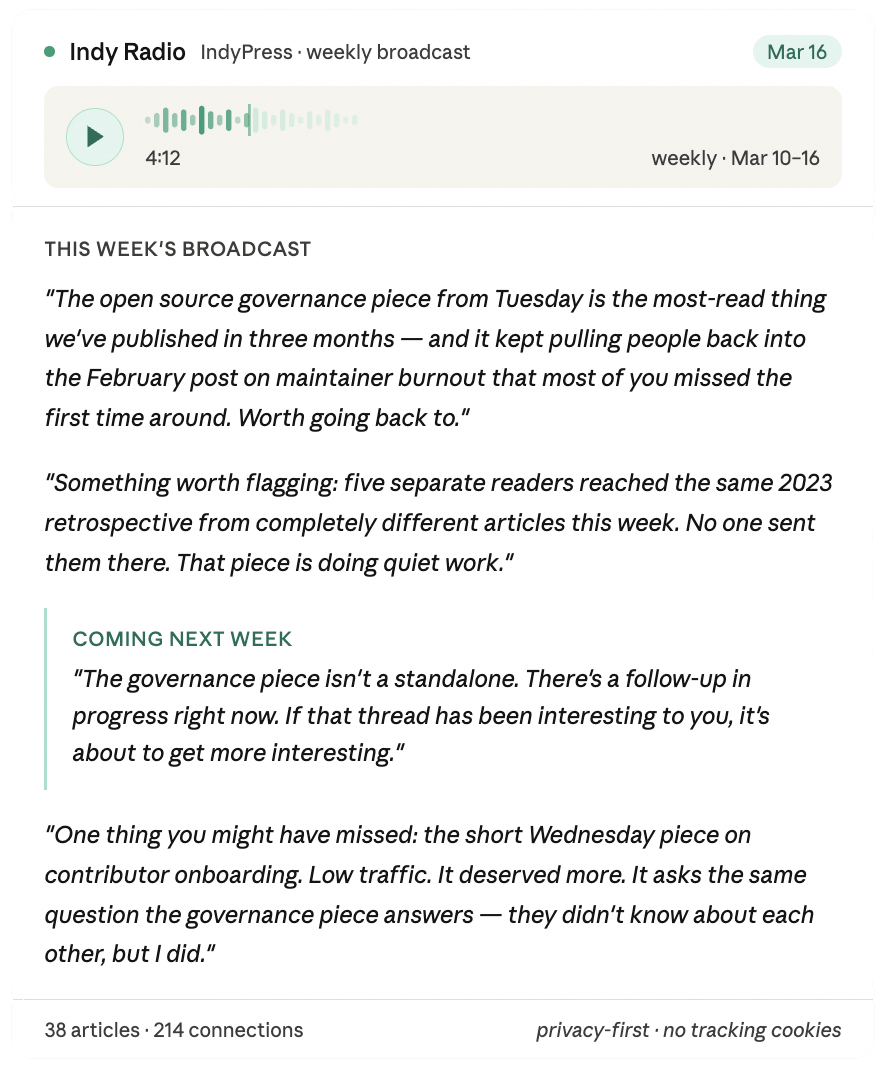
Here's what I realized when I thought it through clearly: Indy Radio isn't just a better implementation of Island Radio. It's a fundamentally more capable narrator.
Island Radio can tell you what everyone already saw. Its DJ is a reporter of shared experience — valuable, but bounded. The DJ knows exactly what the audience knows, because they both watched the same feed.
Indy Radio knows more than its audience does.
The Learning Index has read everything the publication has published, understood how it connects, and tracked what the community engaged with in aggregate. But the editors know things the readers don't yet — which articles are in progress, what writers are currently assigned to, what threads the publication is about to pull. That editorial knowledge gets folded in. The DJ isn't just synthesizing the past. It has a view into what's coming, and can connect what happened last week to what's about to happen next week in a way no individual reader can anticipate.
Island Radio's DJ stood in the town square and reported what the town had already experienced together.
Indy Radio's DJ has read every letter the community sent — individually, privately, without knowing what the others wrote — and also knows what the editors are planning to say next. It can tell you what you missed, connect what happened in fragments, and give you a glimpse of where it's all going.
That's a different thing entirely.
To be straightforward: this isn't built yet. Indy is in active development, the Learning Index is the foundation everything else depends on, and Indy Radio is the feature that sits at the top of the stack. I'm publishing this now because the architecture is clear enough to be worth explaining before it exists — and because understanding where it came from is part of understanding what it's for.
The Convergence
I've been sitting with this for a few months and I'm still not quite used to it.
In the first essay I mentioned that NASCAR and Formula 1 independently arrived at the same design solution — the timing tower — from different histories, different contexts, different design constraints. Two sports that had never compared notes, both concluding that the right way to make a race legible was a compact ranked column showing position and gap in real time. Not influence. Parallel discovery.
This is the same thing.
Island Social was a 2021 project. I designed it, believed in it, put it down unfinished, and mostly moved on. Island Radio was the part I loved most. I never built it because I couldn't solve the shared feed problem — you can't have a town crier without a town that experienced something together. I thought that meant the feature was blocked on a social condition I didn't know how to produce.
Indy Radio emerged from a completely different project, years later. Publishing platform. Content discovery. Editorial intelligence. No conscious connection to Island Social at all.
And then I looked back — and they were the same idea.
Not similar. The same question, arriving from opposite directions: how do you make a community's shared story visible to the people living it? Island Social tried to create the shared story first and narrate it afterward. Indy Radio constructs the narration from stories that were never shared, by synthesizing the collective knowledge that shared experience would have produced. Different path. Same destination.
NASCAR and F1. Island Radio and Indy Radio. I don't think that's coincidence. I think some design problems are load-bearing enough that anyone working seriously in the space eventually finds them, regardless of where they started.
When I recognized the convergence, I also recognized something about where it came from. The thing I'd been circling — in the Island Social design, in the Learning Index, in the Radio feature I kept wanting to name — wasn't a product insight. It was older than that. It was the specific texture of actual knowing on a barrier island with three thousand people. Everyone in the same feed. The same events, moving through the same network, arriving warm and attributed through people you knew.
I didn't grow up thinking that was special. I thought it was just what living near other people felt like.
I was wrong about that. And I didn't find out until I spent years working on the same problem without knowing that's what I was doing.
This is the second in a series. The first essay — about the interface pattern that started all of this — is here.
FunnelMelt builds publishing systems for independent voices. The Indy theme, the Norman theme, and the design thinking behind them live at funnelmelt.com.